Nnena Kalu, the Turner Prize, and What It Means for Disabled Artists
In December 2025, something happened in British art that felt genuinely historic. Nnena Kalu is a 59-year-old sculptor who makes vast, cocoon-like hanging structures from VHS tape, masking tape, clingfilm, and cardboard tubing. She has became the first artist with a learning disability to win the Turner Prize since its inception in 1984. She beat three other shortlisted artists at a ceremony in Bradford last year.
I have been thinking about this a lot. As an artist with my own experience of navigating systems that are not built for people like me, and as someone who has spent a significant part of my academic career researching disability, rights, and inclusion, Kalu's win landed differently than most art world news tends to. It felt like a lot of people didn't take her seriously. It was suggested that she did not understand the prize or the ceremony and some people i spoke to thought that her facilitators were somehow exploiting her.
What Kalu's work actually is
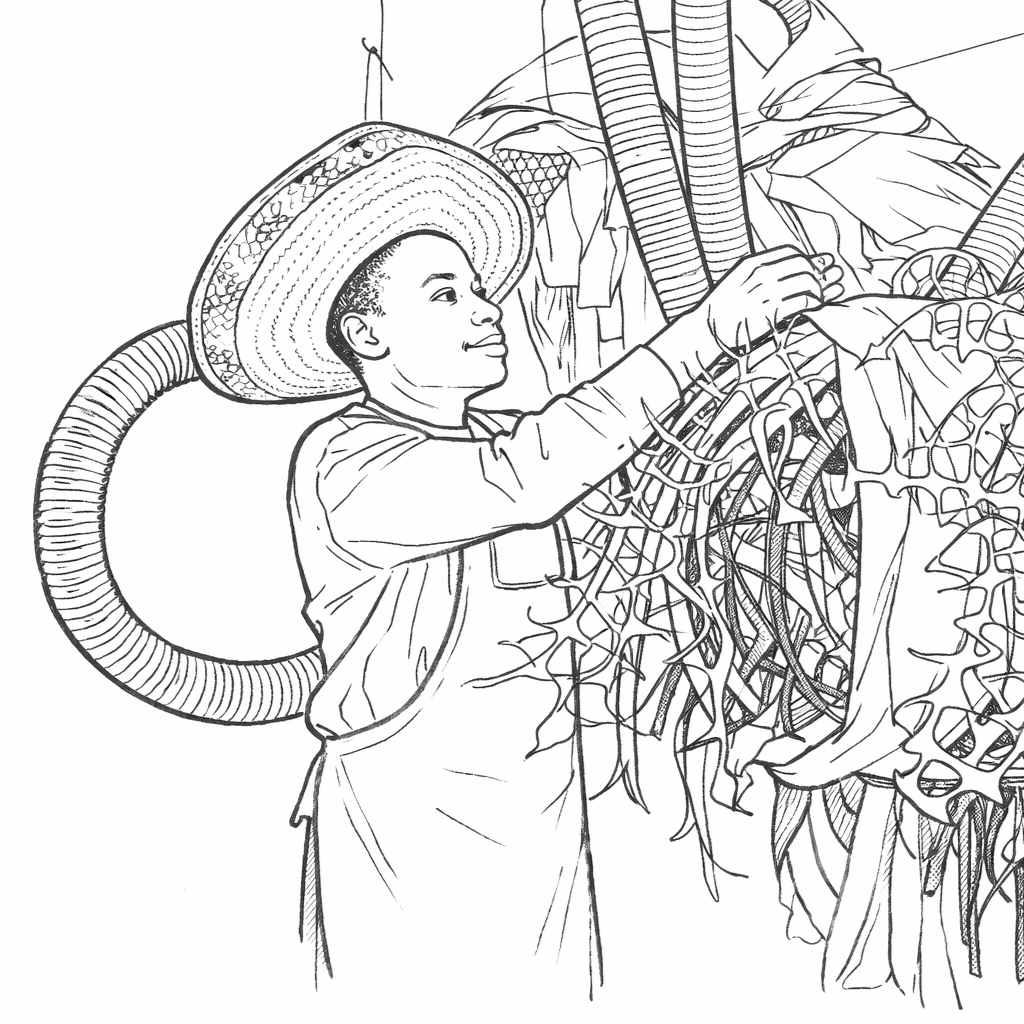
It is worth starting with the work itself, because the temptation in coverage like this is to make it about representation and leave the art as a footnote. Kalu has developed a unique, wordless artistic vocabulary shaped by autism and limited verbal communication. She has worked with ActionSpace since 1999, exploring repetition, layering, and bodily movement as central components of her work. Her sculptures use repurposed materials like VHS tape, flexible ducting, rope, fabric, and clingfilm that are twisted, wrapped, and bound into large cocoon-like forms.
The jury praised what they described as her bold translation of expressive gesture into captivating abstract sculpture and drawing. Adrian Searle, writing in The Guardian, said Kalu deserved to win, likening her work to the experimental textiles of Sheila Hicks and describing her sculptures and drawings as "riotous and rhythmic, purposeful and compelling." It actually reminds me of the work of Anna Winberg who I worked with on the communicate conceive connect exhibition. The work is extraordinary on its own terms. Alex Farquharson, director of Tate Britain and chair of the jury, said Kalu received the award solely for the "sheer quality and verve and beauty" of her abstract art.
But the fact that it took forty years for a learning-disabled artist to be in this position tells us something important about how the art world evaluates the value of a body of work and whose art has historically been seeable.
Charlotte Hollinshead, Kalu's artistic facilitator at Action Space, called it a "major moment. Seismic. It's broken a very stubborn glass ceiling." (see here) Farquharson himself acknowledged that the win "begins to erase that border between the neurotypical and neurodiverse artist." (see here)
That border is real. It is structural, not accidental. Disabled artists have historically been routed away from mainstream contemporary art into categories that carry their own condescension such as "outsider art," "art therapy," "community art". These categories qualify the work before anyone has even looked at it. These categories can be supportive environments but perhaps they are more like derision, keeping it at a distance and as a curiosity or "craft". The language of "outsider" already tells you where the speaker thinks the inside is, and who belongs there.
The irony is that much of what the mainstream art world has celebrated is precisely what many disabled artists have always done naturally. There is a long tradition of automatic drawing, process-based making, and emphasis on the primacy of gesture and repetition over academic technique, art that emerges from the body rather than the intellect is nothing new. As critic Mark Hudson observed, Kalu's sensibility connects to "intuitive abstract gestural ways of getting paint on canvas, with origins in surrealist automatism here the artist doesn't come with premeditated ideas, they just let everything come from the subconscious." The surrealists championed exactly this approach. They just did not extend that championship to disabled artists making it for reasons that are difficult to decipher.
What this means in practice
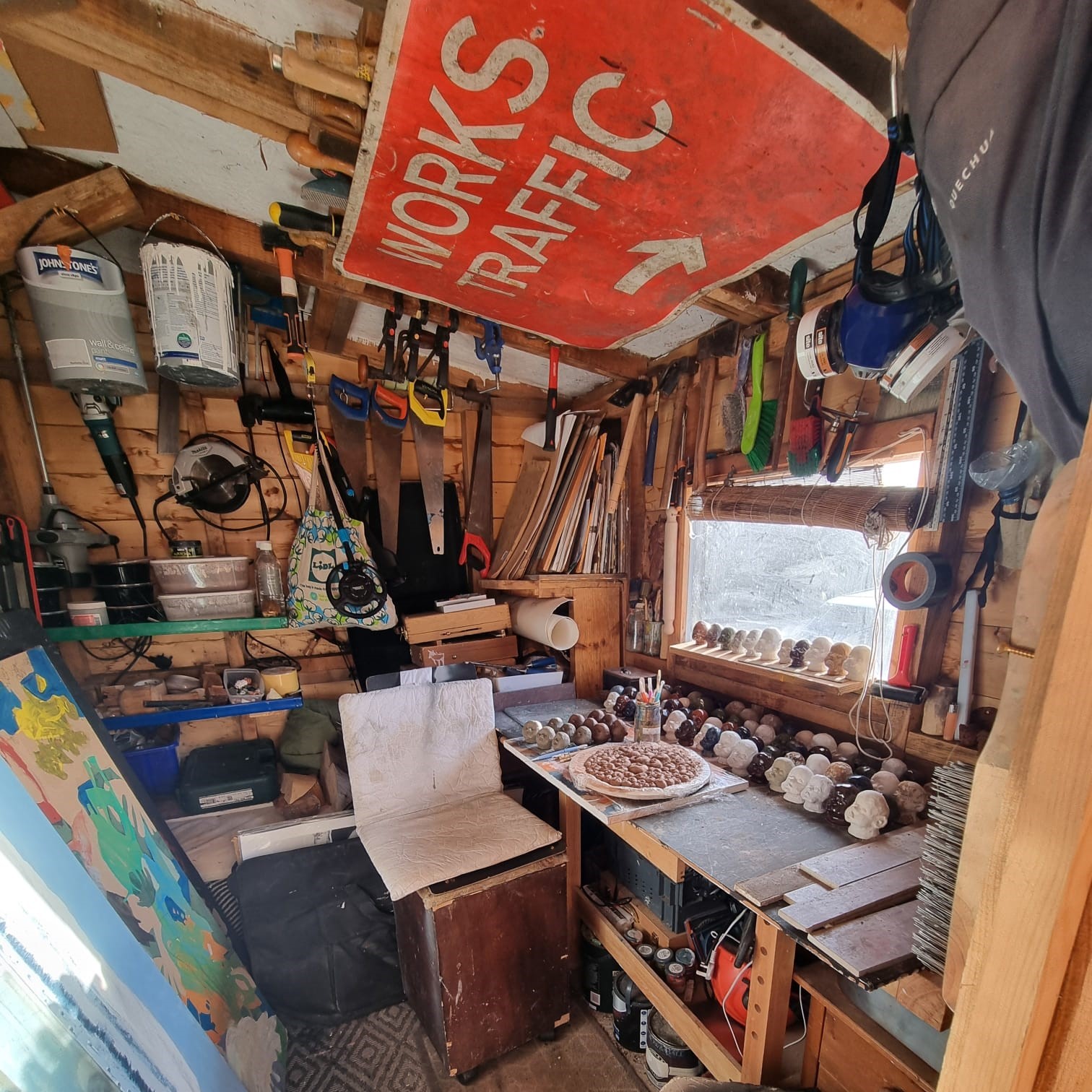
I think about this from my own position. I work across ceramics, wood carving, land art, and painting. My practice is rooted in physical engagement with materials, in repetition and process, in work that resists clean conceptual framing. Much of it comes from places that are hard to articulate such as grief, political anger, care, the desire to make something that holds what language cannot hold. The 20,000 ceramic baby heads of the Vertex Project are made one at a time, by hand, each one different, each one touched. The logic of that project is the logic of mourning and attention, not of career strategy.
I have never experienced the art world as a welcoming institution. It has its hierarchies and its gatekeepers, its unspoken rules about what counts as serious practice and who is taken seriously within it. Disabled artists, and particularly learning-disabled artists or those with mental health challenges, face those gatekeepers at every level, from access to studio space and materials, to funding applications, to exhibition opportunities, to critical coverage. The world is not built for them.
Kalu's win does not change that, and in some ways if it is taken as a token it could be interpreted as job done in terms of disabled representation. However it does allow her work to sit in the mainstream, alongside that of neurotypical, non-disabled artists and mean that such art is potentially "mainstream-able".
It is worth noting that in 2021, Project Art Works, a collective that works with neurodivergent artists in Hastings, was shortlisted for the Turner Prize also, recognising collaborative and community-rooted disabled practice. Kalu's win builds on that moment but goes further and provides an individual disabled artist with recognition. There will be cynics who say this is tokenism, that the prize went to her disability rather than to the work. The problem with this is that the work is genuinely good and deserved the prize more that the other contenders.
Will Kalu's win open doors in a lasting way or become a landmark that institutions point to while continuing to exclude? Galleries, funders, and residencies that shape artists' careers must take note. Artists (disabled or not) should be given the time, space, and resources to develop practices of the depth and duration in the way Kalu has. She has been working with ActionSpace for over twenty-five years and the resources dedicated to nurturing her talent must have been considerable. That kind of sustained development is so important. How do others get the same sorts of opportunities?
Kalu's win is worth celebrating. Should she be a representative of disabled artists in general? I am not sure but what it takes to nurture talent wherever it is lurking is a longer conversation.
Anyway, the Scottish government, I hope, are going to fund me to do a fine arts masters, so hopefully I will have an ActionSpace of my own soon...