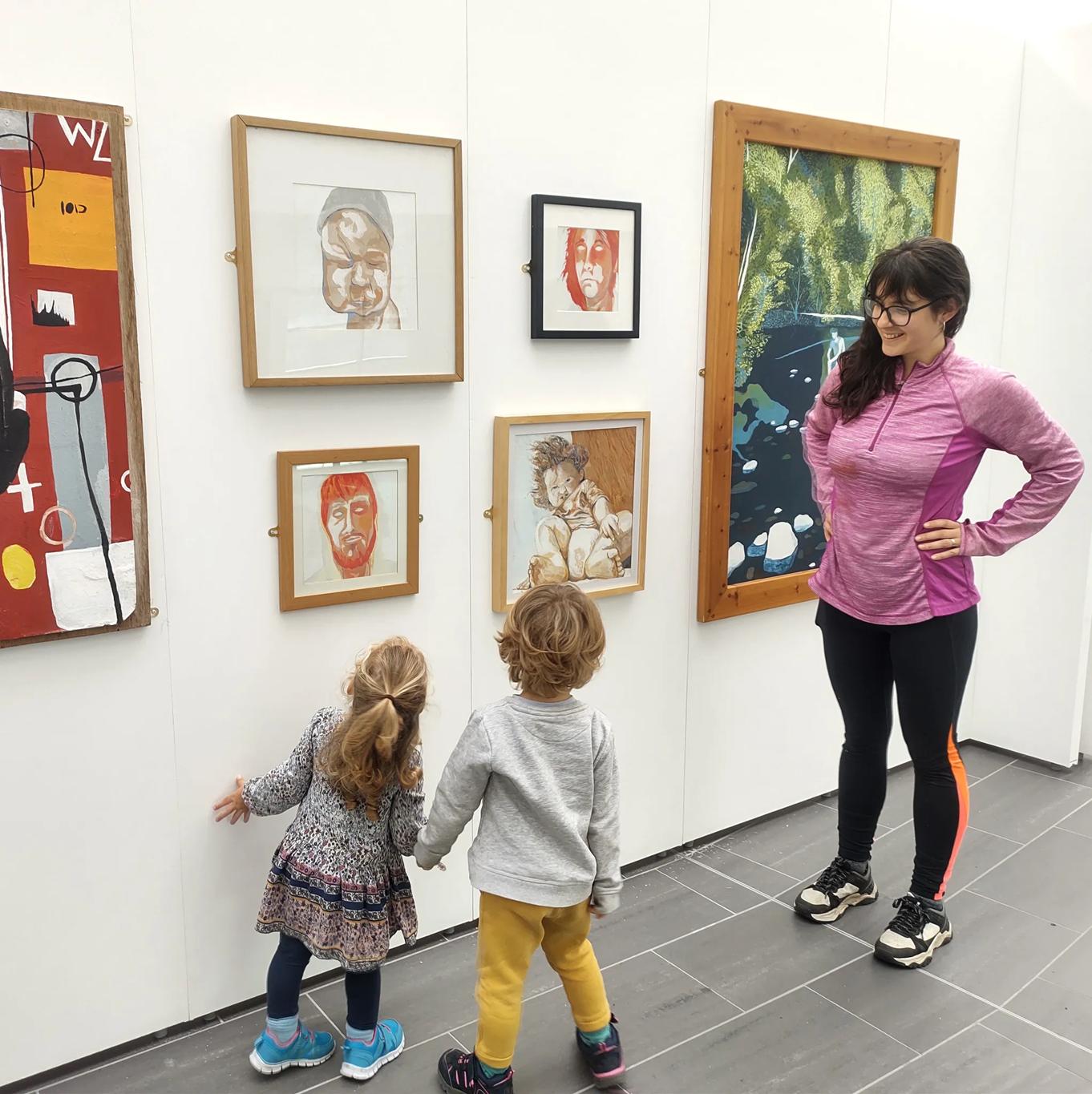
When Grayson Perry delivered his 2013 Reith Lectures he said he would tell us the truth about the art world. He told us the things the “art world” tells about itself, with the virtue signalling and pretensions that great art changes the world or introduces us mortals to a glimpse at divine beauty. But, he argued, that such tastes are also a Goffman style performance. Face work. A declaration to be cool and in-the-know and an insider. The quality of artists and their work is a social agreement between the brokers and gatekeepers of the art establishment who are, surprise surprise, not very neutral.
Perry's central proposition was simple. Art, he suggested, acquires cultural credibility through a set of rituals: the white cube gallery, the critical essay, the art fair, the biennial circuit. These look like systems of evaluation but function more like systems of legitimation, or reification. A self referential loop of people saying “well if they think its good, it must be good”.
To call something good art is not only to make an aesthetic judgement in this context but to invoke an institutional machinery that bestows approval on certain objects and certain makers who have made it onto the map. If a man makes art in the wilderness and no one ever sees it can't ever be good? Is it even art?
To certain people ensconced in institutions and their rituals and rivalries, beauty and value (in astute observation and communication for example) become irrelevant. Taste, an institutionalised form of it, becomes the main social sorting mechanism and this tends to reward what looks like art. The problem is that good art does not always look like art to these people.
So what is good art then if not what the art world say it is? One place to start with this question is Nelson Goodman. In his books Languages of Art (1968) and Ways of Worldmaking (1978), Goodman basically says the question "what is art?" Is irrelevant. He sees it as an essentialist trap preferring the question "when is art?"
This is not just wordplay. By shifting from essence to function, Goodman opens up something philosophically important: an object is functioning as art when it is performing certain kinds of symbolic operations, regardless of what kind of object it happens to be.
Goodman identifies five "symptoms of the aesthetic": syntactic density (every feature of the symbol is significant), semantic density (the symbol refers to things distinguished by subtle differences), relative repleteness (many aspects of the symbol matter, rather than just a few), exemplification (the symbol expresses properties it literally or metaphorically possesses), and multiple and complex reference (the symbol refers in several interrelated ways simultaneously). These symptoms do not constitute a definition; they are diagnostic indicators. A work exhibits more or fewer of them, to greater or lesser degrees, and in doing so functions more or less fully as art.
What is interesting about Goodman's account is how it totally sidesteps the question of institutional authority. A painting by an outsider artist who has never heard of modernism, exhibited in a church hall rather than a Mayfair gallery, can still be syntactically dense, exemplificatory, multiply referential. The most unexpected things can still, in Goodman's terms, be doing what art does. The white cube is not part of the symbolic grammar. This, I think, is really important for any discussion of insider and outsider art, because it suggests that the institutional exclusions Perry describes are aesthetic category errors as much as social injustices: they mistake the frame for the substance, or the venue for the work. In my own topological vocabulary the hole is only defined by what is outside it, rather than bothering to look at whats fallen in.
However, Goodman's account is not without its issues. By focusing on symbolic function, he struggles to account for the affective and embodied dimensions of aesthetic experience. He fails to answer the question of why a work might move you emotionally rather than being inert, even when it satisfies his functional test. His is a cognitive aesthetist and while "when is art?" is a better question than "what is art?", it may not be quite the same as "when is art good?" To pick apart that question, we need something more.
Perry is attuned, in a way that academic aesthetics sometimes is not, to the theatrical and performative dimension of the art world. Good art, in institutional terms, is partly a performance of confidence. Perry describes visiting artists' studios and noticing that the works he responded to were rarely the most technically accomplished or conceptually sophisticated; they were often the ones that felt certain of themselves and that occupied their space without apology. A mark of the artists will and intentionality.
This certainty, he suggests, is partly aesthetic and partly social. An artist who has been through a prestigious MFA programme, who has had their work taken seriously since their early twenties, who moves in the circuits where artists talk to curators talk to collectors, has absorbed a particular kind of confidence that reads, from a distance, as quality.
The trick of the art world is that this confidence is then reverse-engineered as evidence of merit. The work is good because the artist seems sure it is good; the artist seems sure it is good because they have been told so repeatedly by people who have the authority to say so; the people who have the authority to say so derive that authority from controlling institutions that were themselves established by previous generations of confident insiders. It is a closed loop.
Perry is clear that he is not arguing against aesthetic standards altogether. He is genuinely interested in what makes work compelling, why some images haunt us and others pass through without leaving a trace. But he is arguing that the *social* expression of aesthetic standards has been captured by class interest, educational privilege, and institutional inertia. The taste of the dominant, as Pierre Bourdieu argued in Distinction (1979), presents itself as universal but it seems rather parochial from where im sitting.
If Perry articulates these problems with the gentle irony of someone who has, despite himself, wound up inside the institution, de la Puente and Muhammad articulate them from a position that is at once more personal and more structurally precise. Their criticism is not delivered from the podium of the Reith Lectures; it arrives in blog posts written with the urgency of people for whom access to the art world is not guaranteed, for whom the question of what gets called "good" is a matter of livelihood, dignity, and representation.
Their criticism is notably anti-pretension without being anti-intellectual. They are interested in whether art works, whether it makes something happen in the person encountering it, and they are suspicious of the ways in which the art world's rhetorical complexity can function as a fence rather than an invitation. A certain kind of impenetrable curatorial language (what Perry calls "the long words and long faces" of contemporary art) does not signal depth; it signals that the room is not for everyone.
The White Pube have written at length about the exclusions built into how art is reviewed: the assumption that good art is made in cities, by people with time and studio space and cultural capital, about subjects that already circulate within the art world's reference systems. Their criticism opens a counter-canon of works that move them such as video games, illustrations, unfashionable crafts, work by artists that also have jobs as cleaners or care workers.
What they do with their writing is a kind of democratisation of the critical act itself, a refusal to accept that the authority to say what is good belongs only to those who have been credentialed by the art world to say so.
This is not relativism. Both writers have strong and often contrary views; they disagree with each other in print, they publish negative reviews, they hold standards. But the standards they hold are legible, emotional, and argued not merely asserted from behind the authority of institutional position. In Goodmanian terms, they are interested in what symbolic work a piece of art is doing; in Perry's terms, they are alert to when the art world is performing evaluation rather than performing it.
The question of insider and outsider art cannot be fully addressed without attending to money, and Poor Artists the book co-written by de la Puente and Muhammad does exactly this with a rigour and honesty that is rare in arts discourse.
The book's central argument is that the structural conditions of art production the cost of materials, studio space, unpaid internships, MFA fees, the London rent premium, the expectation that artists will work for exposure systematically exclude working-class practitioners, disabled artists, artists of colour, and anyone without a financial safety net behind them.
This is not merely a welfare argument, though the welfare stakes are real. It is an aesthetic argument. When the conditions of art production are structurally exclusive, the art that gets made, exhibited, and canonised will reflect the experience, preoccupations, and reference systems of those who can afford to make it. Good art, as evaluated by institutional standards, will tend to look like the art made by people who had enough money, time, and cultural support to make art that looks, to other insiders, like good art. The category of "quality" then becomes self-reinforcing: what is celebrated is what resembles what was previously celebrated, and what was previously celebrated was made by people whose access to the means of cultural production was structurally advantaged.
Poor Artists is also a work about the impact of this system on the artists inside it. The book describes the particular exhaustion of making work under financial precarity and the way it fragments attention, forces compromise, makes the idealism necessary to sustain a creative life feel like a luxury. Perry, in his Reith Lectures, speaks of the "art world's dirty secret" being that it runs on free labour and inherited wealth. Poor Artists names this not as a secret but as a policy, one that reproduces itself generation after generation and calls itself meritocracy.
The category of "outsider art" or Art Brut, as Jean Dubuffet coined it in the 1940s, emerged as a deliberate counter to institutional taste. Dubuffet, himself a thoroughly insider figure, was drawn to work made outside the cultural system: by psychiatric patients, by self-taught visionaries, by people who had never heard of Cèzanne and didn't care. He argued that such work had an immediacy and vitality that academic art had lost, that the machinery of art education and exhibition culture deadened creative energy rather than sharpening it.
There is something genuinely illuminating here, and there is also something uncomfortable. Goodman's account helps explain the illuminating part: works by artists like Henry Darger, Adolf Wölfli, or more recently Martàn Ramàrez are clearly syntactically and semantically dense, replete, and exemplificatory. They are doing what art does, often with extraordinary intensity, without having received permission to do so. The art world's subsequent embrace of them (the market value of Darger's work, the museum retrospectives, the critical writing) confirms what Goodman's framework predicts: these works were functioning as art and were also recognised as such before they were accepted more widely.
The uncomfortable part is what happens in the act of recognition. When the insider art world "discovers" an outsider artist, it enacts a kind of appropriation: it takes work that was made outside the institutional frame and reframes it within that frame, sometimes without the artist's knowledge or consent (many artists die not knowing their work is worth anything to anyone). The vocabulary of "raw," "primitive," and "untamed" that often surrounds art made by out groups and stigmatised people, carries traces of the same romanticism that European modernists applied to non-Western art. A romanticism that values the other's "instinctiveness" while leaving the other outside the room where evaluation of good and bad art occurs. The same might be said about the recent furore around the recent Turner Prize being given to the (eminently deserving) Nnena Kalu who is non verbal and autistic. She is recognised and her work is valued but is she inside the Cat or is it still playing with her?
Perry addresses this tension obliquely when he talks about authenticity as the art critics fetish. The outsider artist is valued, paradoxically, for their ignorance of the very system that values them. The moment they learn the rules, they risk becoming merely another insider, and their market value may collapse. This is a deeply strange form of evaluation: it rewards the maker for not knowing what they're doing, or at least for appearing not to know.
I don't know whether these observations lead to clear conclusions but we can say that a working account of what makes art good is not possible. It is more like a cluster of conditions that come together in unpredictable ways.
Good art, in Goodman's terms, is art that is doing something symbolically and that is exemplifying, referring, making distinctions, functioning in ways that place demands on the perceiver and reward those demands with understanding, feeling, or altered perception. This is a formal condition, and it is useful precisely because it cuts across institutional boundaries. A work can meet these criteria whether it was made in a Royal College of Art studio or on a psychiatric ward, whether it appears in a Turner Prize exhibition or a community centre.
Good art, in Perry's terms, is art that achieves some kind of moving communication that makes the viewer feel something. Perry is suspicious of art that is primarily about signalling membership of a cultural tribe, art that is "good" only to those who already know what makes it good. His touchstone is the work that surprises, that makes you stop, that produces an experience you couldn't have predicted. This is a vaguer criterion than Goodman's, but it captures something the symbolic account misses: the felt dimension of aesthetic experience, the way a painting or sculpture can reorganise your senses and expectations.
Good art, in The White Pube's terms, is art that matters. Art that has stakes, that risks something, that does not merely confirm what the viewer already believes or already values. Their criticism consistently asks: what is this work for? Who does it speak to? What does it change? These questions are not reducible to social utility, they are interested in formal and emotional power, but they refuse to allow "good" to float free of consequence, to be purely a matter of internal aesthetic properties disconnected from the social world in which art is made and received.
The biography of a work (who made it, under what conditions, with what resources and what constraints) is not irrelevant to its evaluation either but we should perhaps avoid the notion that poverty produces authenticity or that difficulty guarantees depth; those are the romantic fallacies.
The insider/outsider distinction is, finally, less stable than it appears. Artists move across it. Frida Kahlo made work in relative isolation that was then absorbed by the surrealist movement and later by the global art market. Jean-Michel Basquiat moved from street art to gallery representation in a few years, only to have the art world's ambivalence about his insider status haunt his reception throughout his short life. Many artists who are now considered canonical insiders (Blake, Van Gogh, Cèzanne) were, in their lifetimes, various degrees of outsider.
What is constant is not the position but the mechanism of evaluation: the art world continually redraws the line between legitimate and illegitimate production, and the line tends to fall in ways that serve existing distributions of power and capital. The task for criticism and for anyone thinking seriously about what makes art good is to be alert to where the line is being drawn, and why, and by whom, and at whose expense.
Art is a way of worldmaking: a symbolic system through which we constitute versions of reality, test them against experience, and revise them in the light of what we find. The art that gets to make the world that shapes perception, establishes what is beautiful and what is disturbing, what counts as form and what as chaos is the art that gets to define, in some measure, the world we inhabit and we shouldn't leave that important task to others. We should all be engaged in that.
What I've been reading:
- Bourdieu, Pierre. Distinction: A Social Critique of the Judgement of Taste. Trans. Richard Nice. Cambridge, MA: Harvard University Press, 1984.
- de la Puente, Gabrielle, and Zarina Muhammad (The White Pube). Poor Artists. London: Rough Trade Books, 2023.
- Dubuffet, Jean. "Art Brut Preferred to the Cultural Arts." In Outsider Art Sourcebook, ed. Roger Cardinal. Outsider Archive, 1972.
- Goodman, Nelson. Languages of Art: An Approach to a Theory of Symbols. Indianapolis: Hackett, 1968.
- Goodman, Nelson. Ways of Worldmaking. Indianapolis: Hackett, 1978.
- Perry, Grayson. Playing to the Gallery: Helping Contemporary Art in Its Struggle to Be Understood. London: Particular Books, 2014. (Based on the 2013 BBC Reith Lectures.)
- The White Pube. thewhitepube.co.uk.