In the spring of last year I had a vasectomy having decided that we would have no more children than the two we already have. In the months following the surgery, I, for some reason, became more attuned to the numbers of children killed in Gaza. I watched the numbers climb, a story that joined the drip feed of news of children forcibly relocated to Russia from Ukraine, and followed news of teenagers at a music festival in the Negev desert massacred. I remember being very affected by the news from Nigeria of a whole school of so called 276 Chibok girls being kidnapped by Boko Haram never to be seen again. More recently the school bombed during the assault on Iran killing 153 or more at Minab.
I started thinking about how precious children really are. The cliche is that they are the future. That they are irreplaceable. I know all human life is valuable. We are all ends not means. We all are precious. And yet children are so mortal and fragile and it seems even more painful when they are taken before they have a chance to live.
I know there are forces out there that bomb and shoot and snatch without conscience and with impunity. Forces that dismember and dehumanise and that most of us are powerless to stop the people and organisations responsible.
But I also remember visiting the Jewish Museum in Berlin and the shoes piled up. I think about the Shalechet (Fallen Leaves) , an installation of over 10,000 iron faces strewn across the memory void. I think about a piece I saw at Jupiter Artland outside Edinburgh by the french artist Christian Boltanski of a number of sticks with tiny Japanese bells attached, stuck into the soft ground of a small island in the middle of a pond and waving gently in the wind. Each playing the music of a lost soul.
I couldn't imagine all those children and babies' lives and deaths nor their mothers and fathers' pain that I was reading about. But this art managed to convey some of it.
The estimates of children killed in Gaza moved past ten thousand, then fifteen, then twenty thousand and is still climbing. Name after name is written in the book of death (or the spreadsheet?). The reports were of numbers that strip all of this inconceivable suffering down into a manageable, digestible form.
There are reports from Ukraine of the systematic deportation of children. Ukrainian officials estimate over nineteen thousand have been forcibly relocated east across a border and absorbed into a country that is erasing their names and their language and their culture. The numbers are too large. They become a headline and then a sub-headline and then a briefing and then a statistic and then silence.
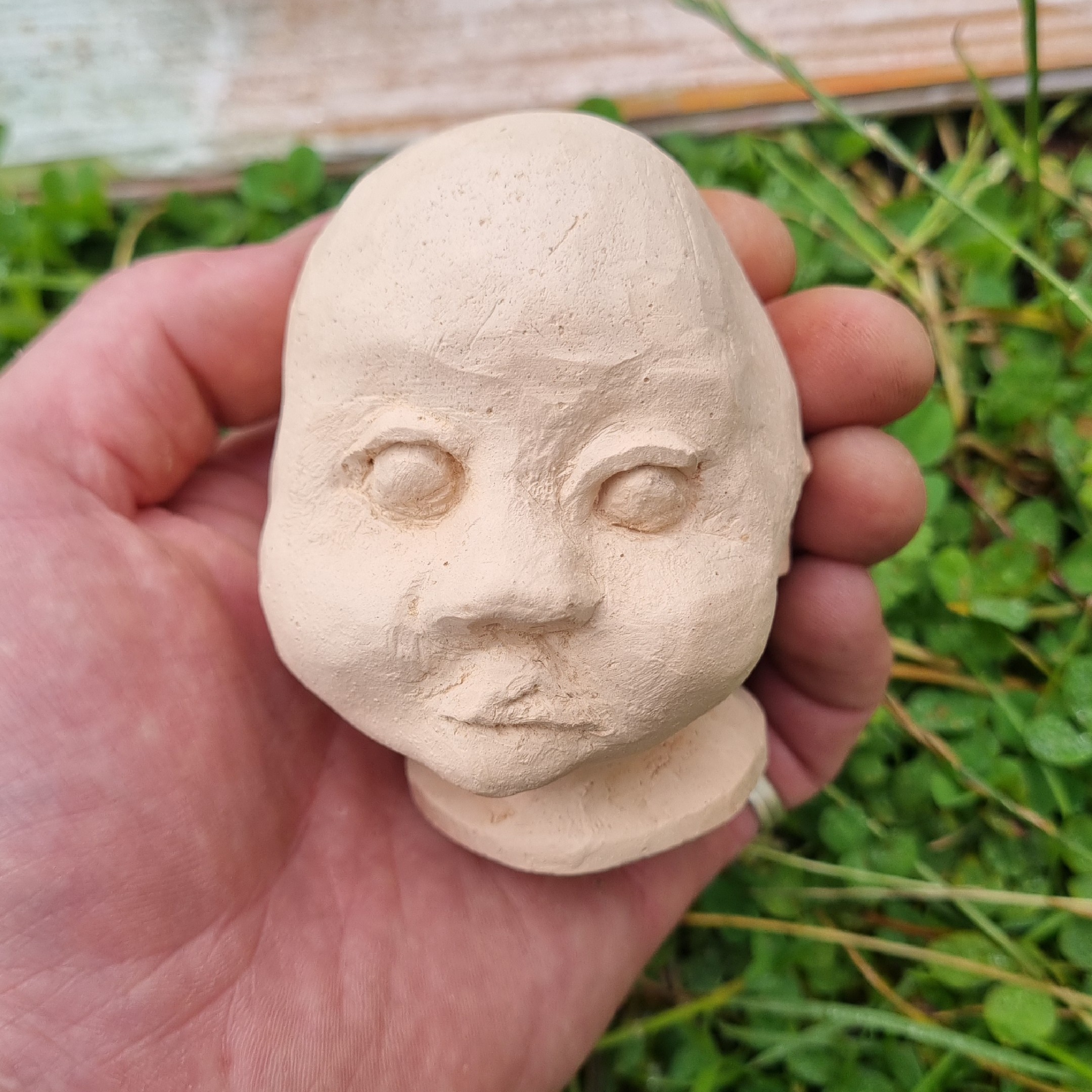
Like some of the artists already mentioned, I have been making art as a response (or processing) of this grief. I make small portraits out of clay. A representation of the lost soul of a child. A bringing back. A return to the world (although as an objectified “thing” or metaphor which sends my mind off in all sorts of worried directions). They are small tokens that are a incomplete attempt to humanise the dehumanised, pulling personality back from the numbers or from racist or genocidal rhetoric. They objectify a life in some way perhaps and they are owned and possessed and vitrified (but not sold). I imagine asking politicians who have avoided or been corrupted by complicity to look them in the eyes.
Perhaps this was a personal response to my vasectomy, perhaps it was a political response, but the babies I make feel alive and I feel like I am nurturing something important. Giving them something back that was taken.
I don't know exactly when the idea arrived, or whether it arrived as an idea at all rather than as a kind of compulsion. I had various types of clay in the studio, terracotta, buff school clay, fine white, and I have pretty much used every technique I can think of so each portrait takes on unique proportion and colour and form. They become individual and ends rather than means.
The proportions are instinctive: the bulge of the cranium, which in newborns is almost comically large relative to the face, the compressed smallness of the features, the ears placed just beyond where you would expect. They looked, to begin with, a little like the heads of sleeping children poking out of the apparently liquefied desk. Putting their heads above the parapet.
The process is slow. I work in between jobs, in the evenings largely after my children are in bed. I sit at the kitchen table with the radio on and make a baby. Then another. The repetition becomes iterative. Each pass of the thumb over the clay is a small act of attention, of registration of care. A gentle stroke. A comforting touch.
I don't feel like I am manufacturing objects or making artworks. They are not “products” or content. I am, I think, gestating them. Not as slowly as the real thing, but with something of the same quality of attending to an emerging person: the sense that what was forming under my hands is not mine, not made, but discovered under the rubble of our crumbling Civilization. Each baby grows. This one's forehead is wider. This one having something about the mouth that made it amused or serious, a child who notices things or a hungry grumble. This one looks as though it had just been startled, or about to cry, or has that expression of a child who has heard something they don't understand and is mulling it over.
I began giving them names.
This is not, I should say, an original gesture. There is a long tradition of artists doing exactly this, insisting on the particular, the named, the individual, as a rebuke to the anonymising violence of mass death.
In 2009, Ai Weiwei covered the façade of Munich's Haus der Kunst with nine thousand children's backpacks arranged to spell out, in Mandarin, the words a mother had written of her daughter killed in the Sichuan earthquake: She lived happily for seven years in this world. Each backpack was a child. Each child had been erased by the collapse of school buildings that government corruption had left structurally unsound. Ai went further: he and a team of volunteers compiled the names of every child killed, and made a work consisting of a three-hour and forty-one-minute audio recording reading those names aloud. The Chinese government tried to silence him for it. The act of naming, it turned out, was not just a celebration of a life but an act of shaming and of blaming too.
Phil Buehler, a Brooklyn artist, unveiled a work called Wall of Tears in February 2026, on a fifty-foot fence in Bushwick: eighteen and a half thousand names. This reflects the estimated count of children killed in Gaza. It's written on a wall in New York City similar to the Covid wall in London. He cited James Baldwin as his touchstone: that the role of the artist is the same as the role of the lover, to make the other conscious of things they don't see. The naming was the seeing. Without the names, the numbers are a wall in themselves.
Käthe Kollwitz understood this before the century that gave us the word genocide had even started. In her 1903 etching Woman with Dead Child, she depicted a mother so consumed by grief she seems to have shed her human form. Her face pressed into her son's chest, her body hunched into a wild animal cry. It shows us the interior of grief, the experience of losing a child. A visceral immediate loss. She made the work a decade before her own son Peter was killed in World War I.
Friedl Dicker-Brandeis was a Bauhaus-trained artist who, imprisoned in the Theresienstadt ghetto between 1943 and 1944, organised art classes for children in the camp. Before she was deported to Auschwitz and murdered, she packed two suitcases with the children's drawings and hid them. They were recovered after the war and The Jewish Museum in Prague holds 4,387 of them. Of the fifteen thousand children who passed through Theresienstadt, the overwhelming majority were also murdered.
One survivor, Helga Kinsky, remembered that Dicker-Brandeis had transported them away from that miserable ghetto. In the midst of the horror she asked them to draw flowers. Views from windows. An innocent and good world. This is a different kind of memorial act to Kollwitz's grief or Ai Weiwei's audit. It is the preservation not of death but of the life that preceded death, the ordinary imagining-life of children, the proof that they existed in time and dreamed and saw and noticed.
What strikes me, looking at my clay heads on the shelf in the studio, is that I am doing something in between these two impulses. I am not depicting grief in an immediate sense like Kollwitz and I am not preserving the children's own expression. I am doing something stranger and more presumptuous: I am making the children themselves anew. Small heads, eyes closed or suggested, the features worked out slowly under my thumbs. I am manufacturing the evidence of existence, their detritus left behind. I am saying each one of these children deserve care and attention and grief.
Rudolf Arnheim, writing about Picasso's Guernica, described the women and children in that painting as representing innocent, defenseless humanity victimised and said that Picasso understood an assault on children to be an assault on the core of our collective humanity. This feels right.
The problem with “memorials”
Ai Weiwei's earthquake memorials have been criticised for depending on Western art institutions to achieve their circulation, and therefore for potentially commodifying tragedy for Western consumption, turning a Chinese political crisis into a cultural event. In effect virtue signalling for those who make and consume this “content”. The critique is uncomfortable and I think it is partly right. But The Colors That Survived exhibition in New York in January 2025 presenting work made by children in Gaza, raised over sixty-seven thousand dollars for the young Palestinians involved and was described by one sixteen-year-old participant from Rafah as making her feel like she mattered, even when her life was treated like it didn't.
That is not commodification. But the question of who gets to memorialise, in what institutions, for which audiences, and whose grief travels furthest these are not questions I want to avoid.
I am a white artist in Britain making clay heads of children killed in Gaza, Ukraine, and Iran. I did not know these children. I have not spoken to their parents. I am working from news reports and photographs and the overwhelming weight of numbers. There is something presumptuous in this. Perhaps something that participates in exactly the kind of Western art-institutional mediation that the critics of Ai Weiwei are worried about. I have not resolved this question. Although i have not made any money or had any recognition for the work, and still do it...
What I keep coming back to is the alternative: which is to not make the work, which seems to me worse somehow. At least I am thinking about them. At least I am doing something. I don't think it is having any effect, positive or negative, in the wider world.
The Gazan artist Dina Zaurub, who was twenty-two years old when she was killed in an Israeli airstrike on her camp in April 2025, spent the last years of her life painting portraits of people killed by the IDF. She had won an award as a child for a drawing about children's rights during armed conflict. She made the work from inside the experience. I am making it from outside. These are not equivalent positions. But her practice and mine share the fundamental compulsion to preserve and to notice.
The heads are accumulating on the shelf. They are all slightly different and all slightly the same, the way that children are: structurally similar, individually irreducible. I have names for them, and they interact with each other in complex dramas.
I don't know if my baby heads can do anything but be. I don't know if anyone cares about them apart from me. I don't know what thoughts they will inspire when people look at them. What I know is what it felt like to make them: the slow accumulation of attention, head by head by head, the sense of each one becoming more individual rather than less as the work went on, more present, more insistent, more alive as hold them and stroke and smooth their cheeks and foreheads. Gormley says that the task of the sculpture is to make inert materials live. These children live in the space between the absence and the presence of the person, between the number and the name, between life and death. Have I trapped them in purgatory or reincarnated them or just objectified them?
My children sleep upstairs. Somewhere, a parent is remembering a face they will never see again. Somewhere a child lies in a grave next to their whole family.
I make another head. I press my thumb across the forehead. I give it a.
This essay is a work in progress.